
For the people who actually fly private, Mallorca in July and August is the most demanding, most rewarding, and most operationally interesting charter destination in Europe. A practical guide to flying into the island in 2026.
1. Why Mallorca Matters in Private Aviation
If Miami is America’s private jet capital eleven months a year, Mallorca is Europe’s private jet capital for four months a year — and the most concentrated example of ultra-high-net-worth seasonal traffic anywhere in the Mediterranean.
The numbers are striking. Palma de Mallorca Airport (LEPA / PMI) closed 2025 with 33.8 million passengers and 246,486 aircraft movements, the third-busiest airport in Spain and one of the largest leisure aviation hubs in Europe. Of that, the General Aviation Terminal (the private jet side of the field) absorbed roughly 17,593 business aviation movements in 2025 — a number that compresses into about sixteen weeks of genuine peak demand, from mid-June through the end of September.
The European private aviation research institute that tracks business jet movements across 45 major European leisure airports put Mallorca in the top three for private jet destinations in 2023 and 2024, alongside Nice and Geneva. The relative growth tells the same story. The Nice–Palma route alone jumped 137% in 2025, the largest single route growth recorded in European private aviation last year. The pattern is clear: as yacht owners migrate west from the Côte d’Azur toward the Balearics in late June, their aircraft follow them.
What makes Mallorca different from other Mediterranean summer destinations is the combination of factors. It is the largest of the Balearics, with the only runway on the archipelago capable of handling any business jet currently in production. It has a dedicated general aviation terminal physically separate from the commercial terminal, with its own customs facility. It is a Schengen country (Spain) but with a high volume of non-Schengen traffic from the UK, Switzerland, and the Gulf. It is a yachting capital, a cultural destination, a hiking and cycling destination, and a serious food and wine destination — all on a single island that takes roughly 90 minutes to drive across.
If you rent a private jet to Europe in summer, you will at some point in the next few years either fly into Mallorca or be told by your broker that you should have booked it six weeks ago. This guide is built to make sure you do it right.
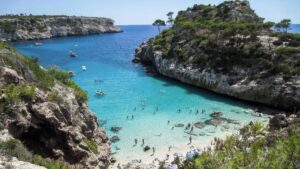
2. The Geographic & Strategic Case
Mallorca sits in the western Mediterranean, roughly 200 km southeast of Barcelona, 300 km east of Valencia, and 250 km south of the French coast. It is large enough to absorb real tourism infrastructure (about 3,640 km²) but small enough that no hotel, no marina, and no restaurant is more than 90 minutes from the airport.
The island combines four things that no other Mediterranean destination quite manages in the same package:
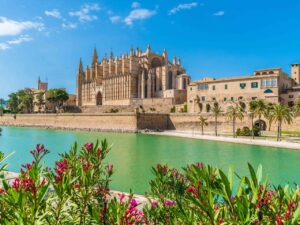
1. A working city with culture. Palma de Mallorca is a real European capital — a Gothic cathedral (La Seu, one of the largest in Europe), an old town (the Casco Antiguo) with serious restaurants and galleries, a Bellver Castle with circular medieval architecture, and a year-round population approaching half a million. Travelers who land for a long weekend can spend Saturday morning in the cathedral, Saturday afternoon in the Joan Miró museum, and Saturday evening at a Michelin-starred restaurant. The city supports the kind of cultural program that Cannes, Saint-Tropez, and Capri cannot.
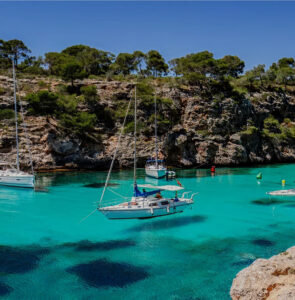
2. A yachting capital of the Mediterranean. Puerto Portals, Port Adriano, Port d’Alcúdia, Port de Pollença, Club de Mar — Mallorca’s marinas are among the most concentrated superyacht hubs in Europe. The “summer migration” pattern is well established: yachts spend June on the Riviera, July and August in the Balearics, September back west. Most of the principals who own those yachts arrive by private jet. The 137% jump on the Nice–Palma route in 2025 is the private aviation footprint of that migration.
3. The Serra de Tramuntana. The UNESCO-listed mountain range on the northwest coast — running from Andratx to Pollença — is one of the most beautiful protected landscapes in Europe. The villages of Deià, Valldemossa, and Sóller are the cultural center of the island. The coastal road from Andratx to Pollença is one of the great drives in the world. Charter clients who come to Mallorca for the beach very often come back for the mountains.
4. A serious food scene. Mallorca currently has multiple Michelin-starred restaurants, including Marc Fosh (the only Michelin-starred restaurant in the Balearics in 2025, located in a converted convent in Palma), Dins (a small tasting-menu restaurant in Palma run by chef Santi Taura), Voro at Cap Vermell Grand Hotel, and Andreu Genestra in the south. Add to that the long-established names — Es Molí de Sal near the salt flats, Sa Foradada in the Tramuntana — and the new openings that cycle through every year, and Mallorca has earned its place in the European culinary conversation.
The combination is unique. The Riviera has yachting but no Tramuntana. Capri has the food but no runway. Sardinia has the coast but no Michelin presence. Mallorca is the only Mediterranean island where a single weekend can be all four — culture, yachting, mountains, food — and the airport to land at is the same one for all of it.
3. The Airport: What You Need to Know About PMI in 2026
The single most important operational fact about flying private into Mallorca is that there is only one practical airport, and it is heavily constrained in summer. Understanding how it works is the difference between a smooth trip and a very expensive lesson.
Palma de Mallorca Airport (LEPA / PMI)
Operator: Aena (the Spanish state airport operator). Runways: Two parallel — 3,270 m and 3,000 m. Both handle everything from a light jet up to a BBJ, ACJ, or ultra-long-range Gulfstream. Hours: 24/7, no curfew. Noise abatement: Voluntary noise restrictions apply after 23:00 local. Departures are constrained, and the practical implication is that “we’ll just leave after dinner” plans can collide with the curfew and push you to the next morning. Plan around it. General Aviation Terminal: The TAG building, located on the east side of the airport complex. Look for the discreet “Aviación General” signs as you approach. The TAG is completely separate from the main commercial terminal, with its own customs facility, its own parking, and its own airside access.
The Slot System
Palma is a Level 3 slot-coordinated airport from June through September. Every arrival and every departure, including private jets, requires a confirmed airport slot.
- Slot window: Slots can be requested starting 14–15 days before arrival. Earlier requests are not accepted.
- Slot tolerance: ±15 minutes. If your flight plan differs from your confirmed slot by more than 15 minutes, the slot is automatically suspended.
- Slot ID: Once confirmed, the slot ID must be filed in Field 18 of the ICAO flight plan as
RMK/LGXXAxxxxxxxxxfor arrivals andRMK/LGXXDxxxxxxxxxfor departures. - The handler does this for you, but the implication for the customer is straightforward: plan ahead, finalize your schedule early, and don’t expect to change your departure time on the day of the flight.
The Parking Constraint — The Detail Most Guides Skip
The runway never limits the aircraft. The parking does.
In July and August, the GAT apron at PMI saturates so completely that the airport regularly denies overnight parking requests — even for light jets. When the airport can’t keep your aircraft on the ground, the operator repositions it empty — usually to Ibiza, Valencia, or the Spanish mainland — and ferries it back empty to collect you at the end of the trip. That repositioning is billed to your charter. In peak week it can add materially to the quote.
New for 2025: from 1 June to 30 September, aircraft longer than 20 meters (essentially heavy jets and above) are limited to a maximum 7-day stay at PMI unless specifically approved by the airport.
There are 49 stands for private aircraft on the GAT. They go fast.
Practical Implications
- Book the handling at the same time you book the aircraft. FBO parking and GAT slots for a July weekend are often gone weeks ahead.
- Keep your aircraft on the ground for short stays. For a 48- or 72-hour trip, paying for the aircraft to sit at PMI is often cheaper than paying for two empty repositioning legs to the mainland.
- Have a Plan B. If PMI is full, the realistic alternatives are limited — Son Bonet (LesB) handles propeller aircraft and is not suitable for jets, so the practical answer is usually to fly into Ibiza (LEIB) or Valencia (LEVC) and complete the trip by ground or by a separate short-leg charter.
- Avoid schedule changes after slot confirmation. Cancelling a confirmed slot means re-submitting the request, which can take days. The airport will not always confirm the new slot.
The 2025 / 2026 Capacity Story
In 2025, PMI’s capacity was set at roughly 74 movements per hour (about 33 arrivals and 40 departures). On the busiest days in August 2026, the airport was forecast to operate beyond declared capacity for 18 days of the month, with ten of those days exceeding capacity for more than two hours. This is the operational reality that explains why July and August prices are 30–60% above shoulder, and why the brokers who handle the Balearics well are worth their margin.
4. The FBOs at PMI: Where Your Trip Actually Begins
Palma has multiple FBOs operating inside or adjacent to the TAG building, and the choice matters more than most customers realize.
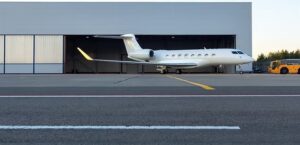
Mallorcair
The most established handler on the field — three decades of FBO operations at PMI, with the largest dedicated space and a strong track record with international operators. VHF 131.925 MHz, SITA PMIZJXH. Mallorcair handles turnarounds, dispatch, customs coordination, and concierge for both passengers and crew. For most customers flying into PMI for the first time, Mallorcair is the default.
Sky Valet Palma
Sky Valet took over the former Gestair FBO and now runs it as part of their Spanish network. Two VIP lounges, a crew lounge, and 24-hour cover. Sky Valet’s strength is consistency — they run FBOs across the Mediterranean and the service standard is predictable.
AviaVIP
One of the more expansive FBO facilities at PMI, with over 500 m² of lounge space overlooking the ramp. A strong option for principals who want space, discretion, and minimal interaction with other passengers.
Aviapartner (formerly Aviapartner Executive)
A full executive ground handling operation at the GAT, with private parking, 24-hour service, and a strong focus on VVIP and discreet arrivals. Sibling of the larger Aviapartner ground handling network.
Universal Aviation, Jet Aviation, and other handlers
Several international handling networks also operate at PMI, either as direct FBOs or as authorized handling agents. The FBO selection is usually determined by the operator, but customers with strong preferences can request a specific FBO at booking.
What a Good FBO at PMI Does
- Customs and immigration airside. Non-Schengen arrivals (UK, Switzerland, US, Gulf) clear customs inside the GAT, not at the main terminal. The process is fast but real.
- Ground transport coordination. Palma is a small airport, but the difference between a good ground operator and a bad one is a 25-minute ride versus an hour in traffic.
- Crew rest and flight planning. Particularly important in summer when crews are on tight duty times.
- Catering. The good FBOs can deliver same-day catering from a small number of quality local providers.
- Concierge. Hotel, restaurant, and marina coordination. The FBOs that work well with the luxury hotels in Deià and Puerto Portals are worth building a relationship with.
5. The Busiest Routes to Palma
Mallorca’s private jet traffic is overwhelmingly European. The geography of the feeder cities reflects three things: high-net-worth populations, the Schengen / non-Schengen line, and the yacht migration pattern.
United Kingdom → Palma
The single most important source market. The UK generated 5.92 million commercial passengers at PMI in 2025, and the private jet traffic follows the same pattern. The most common departure airports are London Farnborough (FAB), Biggin Hill (BQH), Luton (LTN), Stansted (STN) for charter positioning, and in summer Fairoaks, White Waltham, and the private strips of southern England. Flight time is around 2h 15m on a midsize, 2h 45m on a light jet.
Typical pricing on a one-way charter in 2026 starts around €10,000 on a light jet, €13,000–16,000 on a midsize, and €20,000+ on a heavy jet, depending on departure airport and season. All-in round-trip pricing is usually in the €15,000–€25,000 range for midsize and below.
Switzerland → Palma
Switzerland generated 1.3 million commercial passengers at PMI in 2025 (up 5.4%) and punches well above its weight in private aviation. Geneva (GVA), Zürich (ZRH), and Sion (SIR) are the main departure points. One-way pricing starts around €13,000 all-in. The route is heavily used by Swiss-based fund managers, family offices, and the watch industry for summer house rentals in the Tramuntana.
Germany → Palma
Germany was the #1 source market for commercial passengers at PMI in 2025, with 9.84 million travelers. Private jet traffic is correspondingly strong. Munich (MUC), Frankfurt (FRA), Hamburg (HAM), Düsseldorf (DUS), and Berlin (BER) all feed Palma. The route is dominated by midsize and super-midsize, with heavy jets common in July and August.
France → Palma
Paris Le Bourget (LBG) is the dominant French departure point, with Nice (NCE) as the secondary hub — and the Nice–Palma route was the fastest-growing private jet route in Europe in 2025, up 137%. The growth reflects the yacht migration east. Paris pricing starts around €9,000 on a light jet one-way, midsize from €13,000.
Italy & the Eastern Mediterranean
Milan Linate, Milan Malpensa, Rome Ciampino, Naples, and the Italian Riviera feed Palma with corporate and family traffic. From the east, the connections are thinner but real — Athens, Mykonos, and Istanbul all have regular seasonal services.
Russia & the CIS (Historically)
Russian private jet traffic to the Balearics was a major share of the market pre-2022. It has been substantially reduced by sanctions, fleet seizures, and the closure of EU airspace to Russian-registered aircraft. Russian principals still travel via third-country aircraft and operators, but the volume is now a fraction of what it was. This has been partially absorbed by additional Turkish, Kazakh, and UAE-registered traffic.
Transatlantic & Long-Haul
Palma is a small airport by long-haul private jet standards but it can handle the biggest aircraft in production. Heavy and ultra-long-range operators from the US, Brazil, and the Gulf fly into PMI for the summer, particularly in August. The TAG building can clear customs for any size aircraft.
Intra-Balearic
The other Balearic islands — Ibiza (LEIB), Menorca (LEMH) — are often combined with a Mallorca trip. Ibiza is a separate and equally constrained summer destination, and the inter-island private jet traffic is heavy. Many Mallorca-bound clients fly into Ibiza first and then do a short 35- to 45-minute hop over to Palma. This is a useful tactic when Mallorca parking is full.
6. The Real Cost of Renting a Private Jet to Mallorca
Pricing on the Mediterranean summer routes is more volatile than the equivalent US routes, because supply is genuinely fixed (49 stands, no growth in capacity) and demand is genuinely seasonal.
Hourly Charter Rates (2026 indicative)
| Aircraft Class | Typical Hourly | London → Palma (2h 30m) | Geneva → Palma (1h 50m) | Paris → Palma (2h) |
|---|---|---|---|---|
| Light jet (Citation CJ3, Phenom 100) | €3,500–€5,000 | €9,000–€13,000 | €7,000–€10,000 | €7,500–€11,000 |
| Midsize (Citation XLS+, Hawker 900) | €5,500–€7,500 | €14,000–€19,000 | €10,500–€14,000 | €11,500–€15,500 |
| Super-midsize (Challenger 350, G280) | €8,000–€11,000 | €20,000–€28,000 | €15,000–€20,000 | €16,500–€22,000 |
| Heavy (Falcon 900, G450) | €11,000–€14,000 | €28,000–€36,000 | €21,000–€26,000 | €22,500–€28,500 |
| Ultra-long-range (G650, Global 6000) | €14,000–€20,000+ | €36,000–€50,000+ | €26,000–€37,000+ | €28,000–€40,000+ |
These are all-in one-way numbers including handling, FBO fees, fuel, crew, and catering for a typical configuration. Round-trip pricing is usually 15–25% lower per leg if the aircraft stays on the island.
What’s Driving Cost in 2026
- Fuel. Mediterranean Jet-A pricing in 2025–2026 has been more stable than 2022–2023 but is still the single largest line item.
- Crew. Schengen operations are easier than US because crews can home-base more flexibly, but per-diem and overnight costs in Mallorca in summer are not cheap.
- Landing and handling. PMI’s GA landing fees are reasonable. The real cost is the FBO handling — typically €500–€2,500 depending on aircraft size and services.
- Repositioning. The hidden cost in July and August. If PMI is full and your aircraft has to ferry to Ibiza or Valencia, that empty leg is on your invoice.
- Event-week premiums. The Copa del Rey regatta (usually late July / early August), the Pollensa music festival, and the peak yacht week drive 20–40% premium pricing.
- The Balearic Sustainable Tourism Tax. Since 2016, the Balearic Islands have levied a daily tourist tax on overnight stays. The 2025 rate is €1 to €4 per person per night depending on the type of accommodation, with a 50% reduction from the ninth night onward. Hotels add this to the bill. Yachts berthed in marinas pay a separate daily mooring fee. Private jet customers don’t pay an arrival tax, but the FBO and marina bills do include the island’s elevated summer service rates.
What’s Not in the Headline Price
- Catering on board. Allow €150–€500 per person for proper catering, depending on route and request.
- Ground transport in Mallorca. A chauffeured Mercedes V-Class or Range Rover for a day runs €600–€1,200. A 7-series BMW or equivalent for a week is more like €3,000–€5,000 all-in.
- Marina fees at Puerto Portals or Port Adriano. Berthage for a 30-meter yacht in August can run €1,500–€3,000 per night. Larger yachts scale accordingly.
- Hotel. The top hotels in Mallorca in summer start at €1,500–€2,500 per night and rise quickly for the suites that charter clients typically want.
7. The Calendar: When to Fly, When to Avoid
Mallorca’s private aviation season is intense and short. Knowing the rhythm saves money and stress.
Peak Season (July 1 – August 31)
The eight-week peak. Pricing is at the top of the market, slots and parking are tightest, and the FBOs are running at full capacity. Book four to six weeks ahead for a weekend, two to three weeks for midweek.
Shoulder Season (Mid-May to June, September to Mid-October)
The smart money flies here. The weather is good, the marinas are full but not chaotic, the restaurants are accessible, and the pricing on aircraft is typically 20–35% below peak. May and late September are the best weeks of the year in Mallorca — warm enough to swim, cool enough to hike, quiet enough to enjoy.
Off-Season (November to April)
Mallorca in winter is a different destination. The yachts are gone, the hotels are quieter, the restaurants in the villages close. The cultural institutions in Palma stay open. Private jet traffic drops by 80%+ versus summer. This is the right time for a long-stay, a cycling trip, or a quiet week in the Tramuntana — and pricing on aircraft is at its annual low.
The Major Events
- Copa del Rey Regatta (late July / early August, annual): The Copa del Rey is the largest sailing regatta in the Mediterranean, held in Palma Bay. It draws over 100 superyachts and their principals. The week is one of the highest-demand private jet weeks in Europe.
- Mallorca Live Festival (June, annual): A growing music event in Calvià.
- Sunsets at the Serra de Tramuntana (every evening, year-round): Not an event, but the cultural ritual of the island.
- Christmas, Easter, and the long Spanish holiday weekends in May, August, and October all generate private jet demand spikes on top of the underlying seasonal curve.
Best Days to Fly (for cost and availability)
Tuesday, Wednesday, Thursday — always. The weekenders leave Friday afternoon, return Sunday afternoon, and these slots are the first to fill and the most expensive. Midweek flights in July and August are often available within two to three weeks; weekend flights need four to six.
8. Mallorca’s Luxury Ecosystem: Where to Stay and What to Do
The plane gets you there. The island is the point.
Where to Stay
For the Cultural Core: Palma and the Old Town.
- Hotel de Mar — the grandest of the Mallorca grand hotels, set in its own grounds on the southwest coast of the bay. The most consistently excellent service on the island.
- Sant Jaume — a small, design-led hotel in the old town of Palma. Calm, central, walking distance to La Seu and the best restaurants.
- Hotel Can Cera — a 12th-century palace converted to a 14-room boutique hotel in the Casco Antiguo.
- Convent de la Missió — a converted convent in the old town. Quiet, central, the kind of place that doesn’t show up in glossy press but is the pick of many repeat visitors.
For the Tramuntana:
- Belmond La Residencia, Deià — the iconic Mallorca hotel. Two manor houses, 67 rooms, an art collection that includes original Miró and Picasso works. The benchmark against which every other Mallorcan hotel is measured.
- Jumeirah Port Sóller — a contemporary resort at the head of the Sóller valley, with views across the port and the Tramuntana. Strong spa, good food, family-friendly.
- Son Net — a 17th-century finca in the Tramuntana hills, ten minutes from Palma, with serious food and a serious wine list. Owned by the same family behind the Raphael restaurant in Madrid.
- Es Racó d’Artà — a deeply private country estate in the north of the island, known for its wellness and its remoteness.
For the South and the Yacht Set:
- Cap Rocat — a converted military fortress on a private peninsula south of Palma. Dramatic, exclusive, often used for principals who want zero visibility.
- St. Regis Mardavall Mallorca — a large, well-run resort between Palma and Puerto Portals. The standard for families.
- Park Hyatt Mallorca — set inland in Canyamel, with 142 rooms. Strong for golf and spa stays.
- Castell Son Claret — a 17th-century castle estate in the southwest, now a Relais & Châteaux property.
For the Northeast:
- Pleta de Mar — a small, design-driven hotel near Artà, with private villas and a serious restaurant.
- Voro at Cap Vermell Grand Hotel — home of the Michelin-starred Voro restaurant, set in a quiet valley.
Where to Eat
Mallorca’s restaurant scene is now genuinely first-rank. Current standouts (verify Michelin status independently, as the guide updates annually):
- Marc Fosh — Palma. Mediterranean tasting menu in a converted convent. The only Michelin-starred restaurant in the Balearics as of 2025.
- Dins — Palma. Small, ten-seat tasting counter run by chef Santi Taura. Excellent.
- Voro — Cap Vermell. Álvaro Salazar’s two-Michelin-star tasting menu, one of the most ambitious restaurants in Spain.
- Andreu Genestra — Llucmajor. Mallorcan cuisine with a serious modern edge.
- Es Molí de Sal — Ses Salines. Right by the salt flats, the original “destination restaurant” of southern Mallorca.
- Sa Foradada — Deià. A 30-minute walk down from the village to a tiny restaurant on a rock. Worth the hike.
- Bens d’Avall — Sóller. A converted manor house with sea views, strong on local produce.
What to Do
- Yacht charter. The most common activity for private jet clients. The major marinas are Puerto Portals, Port Adriano, Port d’Alcúdia, Port de Pollença, and Club de Mar. Charter yachts in the 25- to 40-meter range start around €35,000–€70,000 per week in July, scale up rapidly for larger vessels.
- The Serra de Tramuntana. The single most beautiful landscape in the Balearics. Drive the road from Andratx to Pollença, walk the GR221 long-distance trail (the “Ruta de Pedra en Sec”), or just stop in Deià for a long lunch.
- Cycling. Mallorca is one of the major cycling destinations in the world, with hundreds of marked routes, organized training camps, and serious infrastructure. Sa Calobra and the Cap de Formentor are the two legendary climbs.
- Watersports. Diving, paddleboarding, sailing, kite-surfing, and swimming are available at every level. Cabrera Island (a national park) is a 90-minute boat ride from Colonia de Sant Jordi.
- Golf. There are more than 20 courses on the island, including Son Gual, Alcanada, and the Arabella Golf courses near Son Vida.
- Art and culture. The Joan Miró Foundation in Palma, the Pilar and Joan Miró Foundation, the contemporary galleries in the Santa Catalina neighborhood, the Fundació La Caixa.
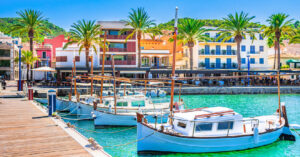
9. Practical Tips for First-Time Jet Renters Flying Into Mallorca
The Mallorca private jet experience is straightforward once you understand the constraints. Here is what first-time customers need to know.
1. Book the handler at the same time you book the aircraft. PMI slots and parking are not separate from the aircraft booking. Your charter broker needs to confirm both the operator and the FBO/handling at PMI at the time of the quote. If your broker doesn’t mention this, you’re working with the wrong broker.
2. Be realistic about the dates. If you want to fly in on a Friday in late July, you need to start the booking conversation four to six weeks ahead. Midweek in shoulder season can be done in seven to ten days.
3. Confirm the slot ID. After your handler submits the slot request, you’ll receive a slot ID. Make sure it appears in the flight plan and that your operator has filed it. A missing slot ID is the most common reason a slot is invalidated on the day of operation.
4. Plan around the 23:00 noise restrictions. Late dinners are part of the Mallorca experience, but the airport’s noise abatement rules make a post-midnight departure impractical. Build in a 22:00 cutoff for the airport and stay for the night if you want to be on the island late.
5. Expect real customs on UK, Swiss, and non-EU flights. Spain is Schengen, but the UK and Switzerland are not. Customs at the TAG is fast — typically 5 to 15 minutes — but it is real. Have your passport and any duty declarations ready. The FBO handles the CBP-equivalent formalities but you are still doing them.
6. The Balearic Sustainable Tourism Tax applies to your hotel. It’s a small line on the bill but a real one. The 2025 rate is €1–€4 per person per night, depending on the type of accommodation. Yachts in marinas pay a separate mooring fee.
7. Have a Plan B airport. The three options for Mallorca overflow are Ibiza (LEIB), Valencia (LEVC), and Menorca (LEMH). Of these, Ibiza is the most operationally useful — same FBO infrastructure, 35-minute flight to Palma, well-staffed handlers. Valencia is the mainland fallback, three hours by car or a separate charter to Palma.
8. Don’t underestimate ground transport. Palma in August is not congested the way London or Paris is, but the routes from the airport to the southwest (Puerto Portals, Andratx, Camp de Mar) and the northwest (Valldemossa, Deià) are narrow and slow. Build 45–60 minutes into your transfer plan.
9. Carry documents in advance. For non-EU customers, the FBO will need passport details for the crew and passengers in advance. The same applies for any non-standard items — pets, weapons, unusual cargo. Surprises at the FBO are slow and expensive.
10. Build a relationship with a Mallorca-focused operator or broker. If you fly into the Balearics more than twice a year, the difference between a broker who handles the islands well and a generalist broker is the difference between a €15,000 trip and a €30,000 trip. The local knowledge matters.
10. The Future of Private Aviation in Mallorca
Several trends are worth tracking if Mallorca is a recurring destination for you.
Sustainability pressure is real in the Balearics. The regional government has been among the most progressive in Europe on environmental policy, including the Sustainable Tourism Tax, restrictions on large cruise ships in certain bays, and ongoing dialogue about private aviation emissions. Expect continued regulatory attention. SAF (Sustainable Aviation Fuel) availability at PMI is improving but not yet at the level of Northern European hubs.
Slot and parking constraints will not ease. The GAT has 49 stands and no significant expansion planned. Demand growth will continue to outpace capacity in July and August, and the slot window (14–15 days ahead) is unlikely to change. The brokers and operators who handle this well will continue to have an advantage.
Yacht-air integration is deepening. Several new FBO and marina partnerships are emerging in the Mediterranean, designed to make the air-to-yacht handoff smoother. The new marina developments at Port Adriano and the planned expansion at Puerto Portals will increase superyacht berth capacity and consequently the private jet traffic that supports it.
Aircraft technology is improving the experience. The newest generation of super-midsize and large jets (the Bombardier Challenger 3500, the Gulfstream G700 and G800, the Dassault Falcon 6X and 8X, the Embraer Praetor 600) all offer lower cabin altitudes, quieter cabins, and meaningfully better connectivity. For long-haul customers, the in-cabin experience on a current-generation G700 or Global 7500 is a significant step up from a five-year-old aircraft.
Regulatory watch. Spain is currently in the process of implementing the EU’s updated emissions trading scheme (EU ETS) for aviation. Private jet operators flying in and out of EU airports must participate. This is unlikely to materially affect pricing in the near term, but it is worth tracking.
11. The Bottom Line
Mallorca is the summer private jet capital of the Mediterranean for reasons that compound: the only real airport in the Balearics, a serious city, a UNESCO-protected landscape, a Michelin-rated food scene, and a yachting culture that brings the world’s wealthiest owners to a single island in July and August.
If you are chartering a private jet into Mallorca for the first time, the path of least resistance is:
- Aircraft class: Light or midsize for most European departures. Super-midsize and above for long-haul or for principals who want full lie-flat comfort on a transatlantic flight.
- Airport: Palma (LEPA / PMI), the General Aviation Terminal, the TAG building. There is no realistic alternative for jet operations.
- FBO: Mallorcair or Sky Valet for most customers. AviaVIP for principals who want maximum space and discretion. Aviapartner for VVIP and complex international arrivals.
- Broker: A European broker with specific Balearic experience. The difference in price between a broker who handles the slot system and a generalist broker is often 20–30% in peak weeks.
- Timing: Shoulder season (May, June, September, early October) if you can. Midweek if you can. Build a buffer around the Copa del Rey regatta in late July / early August.
- Plan B: Have a fallback airport in mind. Ibiza is the practical answer; Valencia is the mainland fallback.
The island will deliver on the other end. Mallorca in 2026 is at the top of its game — a serious cultural destination, a serious food destination, the most concentrated superyacht hub in the western Mediterranean, and the only place in Europe where a single long weekend can be all of those things at once.
The only constraint is getting in. Book early, build a buffer, and have a fallback. The rest is one of the most rewarding private jet trips available anywhere.
This article is for informational purposes. Pricing, schedules, slot rules, and event dates reflect the most current data available as of August 2026 and are subject to change. For current charter quotes and slot availability, contact a Part 135 / EU OPS operator or a reputable European charter broker with Balearic experience.


