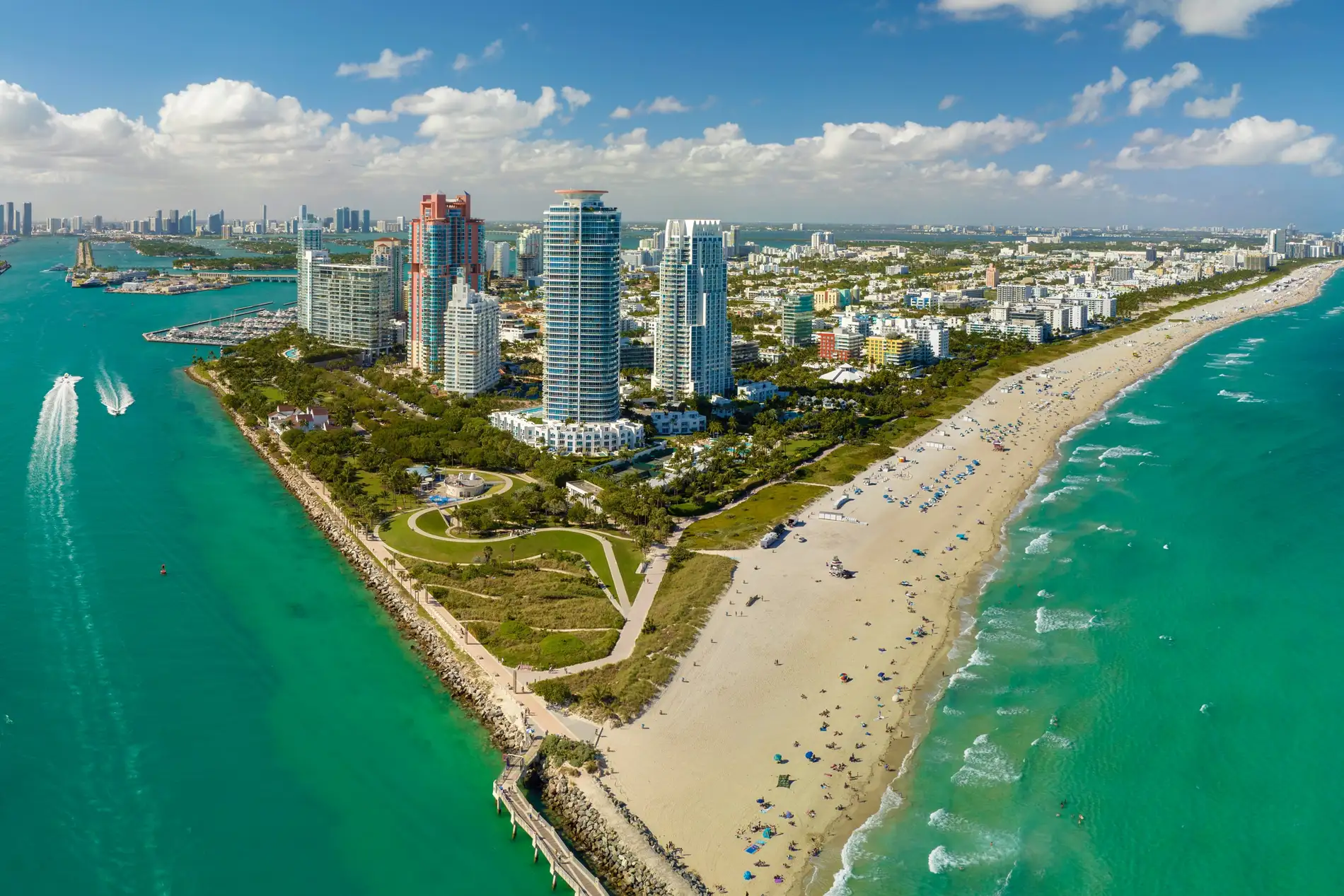
For the people who actually fly private, Miami isn’t just a vacation spot. It’s a year-round engine of business, wealth migration, sport, art, and tax strategy — and the numbers prove it. A practical guide for anyone renting a private jet to South Florida.
1. Miami and the Private Jet Economy: A Match Made in the Tropics
Walk into Opa-Locka Executive Airport on a Thursday afternoon in November and you’ll understand why Miami sits at the top of the private aviation map. Gulfstreams and Globals are queued three deep at the fuel pumps, a Falcon 7X is taxiing past a brand-new Bombardier Challenger 3500, and somewhere in the back of the FBO a hedge fund principal is signing for a late-model Phenom while a Colombian family unloads a Citation Latitude on the next ramp over.
This isn’t a one-off. It’s the daily rhythm of a city that has become, by almost any measurable standard, the most important private jet destination in the Western Hemisphere.
The 2025 data tells the story clearly. Opa-Locka (KOPF) — Miami’s dedicated general aviation airport — ranked #7 in the United States for private jet departures, logging 30,207 departures and growing nearly 4% year over year. Add in commercial-shared movements at Miami International (KMIA) and the larger South Florida cluster (Fort Lauderdale Executive, Fort Lauderdale International, Tamiami, and the nearby behemoth at Palm Beach) and you’re looking at a metro that consistently places five airports in the national top 25 for business aviation.
What makes Miami special isn’t just volume. It’s the type of flying happening here. New York–Miami and New York–Palm Beach remain the two busiest private aviation corridors in the country. Teterboro and Westchester together feed South Florida so heavily that operators schedule repositioning legs around the daily New York departure banks. In 2025, the Teterboro–Opa Locka / Palm Beach corridor was named the highest-scoring UHNW private aviation route in the U.S. by the Haute Living Private Aviation Corridor Report — driven by finance money chasing Florida’s tax structure, family offices wintering on Star Island, and a steady stream of Latin American capital that uses Miami as its first stop on U.S. soil.
Brazilian business jet departures grew 45% year over year in 2025. Colombia was up 42%. Venezuela up 34%. Every one of those flows lands in Florida, and most of them lands in Miami.
If you’re renting a private jet, the question isn’t really whether Miami is a top destination — it is, and it has been for years. The question is how to fly into it well, where to land, what to expect to pay, and how to avoid the most common mistakes. This guide is built to answer all of that.
2. The Geographic & Strategic Case: Why Miami Wins
Before getting into the operational details, it’s worth pausing on why this city in particular dominates private aviation in the way it does.
The Tax Anchor. Florida has no state income tax, no estate tax, and a comparatively friendly trust regime. Since 2020, when remote work stopped requiring physical presence, the wealth migration into South Florida has been relentless. Miami-Dade and the surrounding counties absorbed tens of billions of dollars of new household wealth — and the people who moved that money need to fly back and forth between New York, London, São Paulo, and the Magic City on their own schedule.
The Latin American Gateway. Miami is the cultural, financial, and logistical capital of Latin America by default. It has the largest concentration of Latin American corporate HQs outside of Latin America. Banco Itaú, Bradesco, Banco de Crédito del Perú — they all run their U.S. operations out of Brickell. When a Brazilian, Colombian, Mexican, or Argentine executive needs to be in the U.S. for 24 hours, they fly into Miami. Often on their own plane.
The Cruise & Yacht Axis. PortMiami is the world’s busiest cruise port. Miami Beach Marine and the marinas from Coconut Grove to Fort Lauderdale are the yachting capital of the Americas. Many of the same UHNW travelers who rent private jets also own or charter superyachts, and they want to be where both assets are accessible from a single landing.
The Events Calendar. Art Basel Miami Beach, the F1 Crypto.com Miami Grand Prix, the Miami International Boat Show, Miami Music Week, Ultra, Art Week Wynwood, the Orange Bowl, the Miami Open, Super Bowl–class events at Hard Rock Stadium. There is no week of the year when something significant isn’t happening here, and the private jet traffic tracks every single one of them.
Weather, Mostly. Miami International has fewer weather diversions than almost any major East Coast airport. The Atlantic side of Florida gets afternoon thunderstorms in summer, but the FBOs at Opa-Locka and Tamiami handle them with the kind of operational ease that New York, Boston, and D.C. simply can’t match in winter.
The combination is unique. There is no other U.S. city that is simultaneously a tax haven, a Latin American capital, a yachting hub, a winter destination for the global 1%, and a year-round event venue. As long as that combination holds — and nothing on the horizon suggests it won’t — Miami will keep printing private jet movements.
3. The Airports: A Jet Setter’s Map of Miami

One of the most common mistakes first-time private jet renters make is assuming Miami International is the default. It isn’t, and the difference matters.
Opa-Locka Executive Airport (KOPF) — The Real Hub
Opa-Locka is the private jet airport in Miami. Located about 11 miles north of downtown and roughly equidistant from Miami Beach, Brickell, Bal Harbour, and Aventura, it has the most developed FBO infrastructure, the highest volume of business jet movements, and the most experienced line crews. In 2025, KOPF recorded 53,920 total business aviation movements — the seventh-highest in the U.S.
Three major FBOs operate on field: Atlantic Aviation, Signature Flight Support, and Million Air, plus a number of independent charter operators and management companies based on the ramp. If you’re flying into Miami on a chartered jet, you are most likely going to land at OPF.
The runway is 8,002 feet, more than enough for any midsize, super-midsize, or large-cabin jet. Customs and Border Protection has a dedicated general aviation facility on field, which means international arrivals clear without having to drive over to MIA.
Miami International Airport (KMIA) — When You Need a 747
For very large aircraft — Global 7500s, G700s, BBJs, ACJ Two Tens, and any number of commercial-style VIP charters — Miami International’s longer runways and bigger FBO capacity start to make sense. The Signature Flight Support terminal on the east side handles most large-cabin and international arrivals, and there is a general aviation customs facility for cleared international operations.
MIA is also where most of the truly long-haul international private jet traffic arrives: London City, Paris Le Bourget, Zurich, Dubai, São Paulo Guarulhos. The trip from MIA to Brickell is about 20 minutes; to Miami Beach around 30 to 40 depending on time of day.
The trade-off: MIA has heavier commercial traffic, tighter slots at peak times, and customs waits during major events. For a Citation XLS coming in from Westchester, it’s overkill. For a BBJ from Munich, it’s the right call.
Miami Executive Airport (KTMB) — The Quiet Southern Option
Formerly Kendall-Tamiami, Miami Executive sits roughly 13 miles southwest of downtown, well-positioned for Coral Gables, Pinecrest, and the southern suburbs. It has a 6,001-foot runway, two solid FBOs (Atlantic and Signature), and significantly less congestion than OPF.
If you’re based in the southern part of Miami-Dade — Coral Gables, Coconut Grove, Cutler Bay, Pinecrest — TMB can save 20 to 30 minutes of ground time. It’s also a popular option for customers wanting to avoid the public visibility of Opa-Locka.
Fort Lauderdale Executive (KFXE) — Broward’s Answer
Technically across the county line, but KFXE is increasingly the airport of choice for customers headed to Fort Lauderdale, Hollywood, Weston, Parkland, or the western suburbs. Sheltair runs a strong FBO here, and Banyan Air Service has been on field for decades. Runways are 6,000 and 4,200 feet, fine for any light through super-midsize, marginal for heavy iron in summer.
Fort Lauderdale-Hollywood International (KFLL)
Commercial primary. Used by some charter operators for heavier aircraft but rarely the first choice for a private jet customer. The one exception: when there’s a cruise embarkation from Port Everglades and the operator wants to minimize ground time.
The “Should I Use OPF or MIA?” Decision Tree
- Aircraft under a Global 6000 / G650 and you’re headed to Miami Beach, Brickell, Aventura, Bal Harbour, Design District, or Coconut Grove → OPF.
- Aircraft is a G700, BBJ, ACJ, or anything with international crew change requirements → MIA.
- Aircraft is midsize and you’re staying in Coral Gables or further south → TMB.
- Aircraft is light or midsize and you’re staying in Broward → FXE.
4. Inside the FBOs: What Actually Happens When You Land
The FBO — Fixed Base Operator — is where the actual private jet experience begins. Walk through the wrong door and you’ll feel like you’re at a regional airline terminal. Walk through the right one and you’ll understand why people pay a premium for this.
The Major Miami FBOs
Atlantic Aviation OPF is the busiest private aviation facility in Florida by movement count. Multiple hangars, a recently renovated terminal, full concierge, and the kind of staffing depth that means a 9 PM arrival on a holiday weekend still gets met with the same professionalism as a noon arrival on a Tuesday.
Signature Flight Support OPF is the legacy operator with a large footprint and consistent service. Their MIA location handles most of the very-large-cabin and international traffic; their OPF location is the workhorse for domestic charter.
Million Air OPF is a smaller boutique option with excellent crew facilities and a more private feel — favored by repeat customers who want a quieter arrival.
Sheltair KFXE in Fort Lauderdale has built a reputation for being particularly strong on international handling and customs, and is the first choice for many of the yacht-bound customers who keep their jets at FXE.
Atlantic Aviation TMB and Signature TMB round out the southern option.
What a Good FBO Actually Does
- Ramp and line service — fueling, GPU, lav, water, de-icing (rare in Miami but happens in cold snaps in January when northern crews are surprised), baggage handling.
- Crew lounge and snooze room — a dealbreaker for many operators. The best FBOs have quiet crew areas, flight planning with all the usual tools, weather, and catering.
- Passenger concierge — car service, hotel, restaurant, the FBO’s preferred list. The good ones actually pick up the phone and book things for you.
- Customs and immigration — at OPF, the CBP general aviation facility is on field. You clear in the FBO, not at a commercial terminal.
- Catering and provisioning — most major U.S. catering brands (Airport Gourmet, Cruising Kitchens, Lavender) service Miami. The best FBOs coordinate same-day requests.
- Security — discreet, professional, and trained in handling high-profile arrivals. The major Miami FBOs have done this for celebrity, political, and principal clients many thousands of times.
Tip: Tell Your Charter Broker Your Ground Preferences
The FBO choice is set by the operator, but you can — and should — express a preference. If you want privacy, say so. If you want to be walked directly to a specific vehicle, ask the broker to coordinate with the FBO in advance. If you have security requirements, communicate them at booking, not at landing.
5. The Calendar: When Miami’s Private Jet Traffic Goes Vertical
If you can choose when you fly, choosing well can save you both money and hassle. These are the peaks.
F1 Crypto.com Miami Grand Prix (May 1–3, 2026; ~May 7–9, 2027)
The F1 race at the Miami International Autodrome in Miami Gardens has become the single biggest private jet event in the United States outside the Super Bowl. In 2025, F1 weekend generated 1,314 private jet arrivals — the highest since the race debuted. It still trails the 1,492 from the inaugural 2022 event, but the trend is clearly back up.
Most F1 traffic uses OPF, with overflow into TMB and KFXE. Expect:
- Ramp parking by reservation only — book early, often 6+ months out
- FBO handling surcharges during race week ($200–$500+ per leg is not unusual)
- Hotel inventory gone by January
- Charter prices up 30–60% peak vs. shoulder
Art Basel Miami Beach (December 4–7, 2025; first week of December annually)
Art Basel is the December spike. Galleries, fairs in Wynwood and the Design District, collectors from everywhere, and a private jet arrival curve that builds for two weeks before the fair and tails off a week after. The Miami Art Week ecosystem has expanded to include Design Miami, Untitled, Scope, and a dozen satellite fairs, and the week is the busiest non-F1 stretch on the FBO calendars.
Miami International Boat Show (mid-February annually)
The boat show generates significant private jet traffic from the yachting and brokerage community. Many customers fly in, see the show, and continue on to the Bahamas or Caribbean by yacht or by a second short-leg private flight.
Miami Music Week & Ultra (late March)
March is the third big peak. Ultra Music Festival at Bayfront Park, plus the surrounding club week, draws tens of thousands of international visitors and a lot of last-minute charter demand.
The Miami Open (late March – early April)
The tennis tournament at Hard Rock Stadium is a quieter but still significant spike, particularly for European and Latin American principals who combine it with vacation time.
Year-Round Wealth Migration Traffic (November – April)
The “winter season” — Thanksgiving through Easter — is when Miami’s private jet infrastructure is most stressed. Every weekend brings a wedding, a family gathering, a yacht charter, a launch event, or a board meeting. The Saturdays heading into Miami on a weekend afternoon in February, and the Sundays heading out, are consistently the most operationally challenging days for the FBOs.
Best days to fly for cost and availability: Tuesday, Wednesday, Thursday. Worst: Friday afternoon, Sunday afternoon, and any day adjacent to a major event.
6. The Real Cost of Renting a Private Jet to Miami
Pricing is the second most common question after “where do I land.” The honest answer is that it varies a lot, but here are real numbers for 2025–2026.
Hourly Charter Rates (One-Way or Round-Trip)
| Aircraft Class | Typical Hourly | NYC–Miami (2h 45m) | LAX–Miami (5h) |
|---|---|---|---|
| Light jet (Phenom 100, Citation CJ3) | $3,500–$5,000 | $9,500–$14,000 | $17,500–$25,000 |
| Midsize (Citation XLS+, Hawker 900XP) | $5,500–$7,500 | $15,000–$21,000 | $27,500–$37,500 |
| Super-midsize (Challenger 350, G280) | $8,000–$11,000 | $22,000–$30,000 | $40,000–$55,000 |
| Large (Gulfstream G450, Falcon 900) | $11,000–$14,000 | $30,000–$38,000 | $55,000–$70,000 |
| Ultra-long-range (G650, Global 6000) | $14,000–$20,000+ | $38,000–$55,000 | $70,000–$100,000+ |
Round-trip typically includes a multi-day or overnight stay, which means the aircraft has to either deadhead back or sit. Most operators will discount or bundle the return leg if you keep the plane for a few days. The cheapest “NYC to Miami and back” flight on a light jet is usually in the $14,000–$20,000 range if you go midweek, off-event, and stay at least one night.
What’s Driving Cost Right Now
- Fuel. Jet-A pricing in Miami has been relatively stable in 2025 but varies with global crude. The largest single line on the operator’s invoice.
- Crew. Two pilots for a small jet, three for a large, plus per-diem and overnight costs.
- Landing and handling. OPF landing fees are modest; FBO handling is the bigger number — typically $400–$1,500 depending on services and aircraft size.
- Catering and ground. Easy to underestimate. A long-haul charter with proper catering, ground transport, and hotel coordination can add several thousand dollars to the bill.
- Positioning. If the aircraft has to reposition empty to pick you up, those hours are usually charged (though many brokers negotiate “repositioning included” terms for high-value customers).
- Event-week premiums. F1, Art Basel, the Boat Show, and Super Bowl–class weeks can see 30–60% premium pricing on the same aircraft.
The Hidden Cost Most First-Timers Miss
Deadhead. If you book a one-way from Teterboro to Miami and don’t return on the same aircraft, the operator still has to fly the plane home — and depending on where their base is, that can be 2 to 4 hours of unpaid flying. Most operators pass this on as a “repositioning fee” or “ferry charge” if it wasn’t negotiated into the original quote. Always ask: Is this a round-trip charter or one-way? What’s the repositioning cost if I go one-way?
Jet Card vs. On-Demand Charter
If you fly the Teterboro–Miami route more than three or four times a year, a jet card is usually worth modeling. Programs from NetJets, Flexjet, VistaJet, JetSuite, and Wheels Up offer guaranteed availability on specific cabin classes for fixed hourly rates (plus a daily two-hour minimum). The 2025 fleet leader by movements is NetJets, with 5,173 aircraft in managed operations.
Jet cards are not always cheaper than on-demand for a single flight, but they trade peak-day premium pricing for predictable cost and confirmed availability — which during Art Basel and F1 week, when demand is most extreme, is often worth more than saving 10% on the hourly rate.
7. The Busiest Routes Into Miami
If you’re considering a Miami private jet trip, these are the routes the industry tracks most closely.
New York ↔ Miami (The Heavyweight)
The single most important private aviation corridor in the country. The Miami–New York route logs roughly 700+ flights per month in peak season, with a year-round average near 500. Year-over-year growth in early 2026 was tracking around 14.7%.
Departure airports: KTEB (Teterboro, the #1 U.S. private jet airport with 75,029 departures in 2025), KHPN (Westchester), KISP (Long Island MacArthur), and increasingly KFRG (Republic) and KFOK (East Hampton in summer).
Aircraft in play: everything from a Citation CJ3 for a 90-minute solo flight to a G650 for principals who want full lie-flat comfort on the same 2h 45m hop.
Los Angeles ↔ Miami
The transcontinental workhorse. 5+ hours, almost always a super-midsize minimum, often a large cabin for principals who want to work or sleep. KVNY (Van Nuys) and KSNA (John Wayne / Orange County) are the most common departure points; KSFO and KOAK handle some. The route is heavily trafficked year-round but spikes during awards season (January–March) and the F1 / Art Basel windows.
Chicago / Midwest ↔ Miami
The “snowbird” corridor. KMDW, KORD, KPWK, KDSM, KMSP all feed Miami heavily from October through April. The route is generally flown in a midsize or super-midsize.
Dallas / Texas ↔ Miami
KDAL (Dallas Love Field, the #2 U.S. private jet airport) and KHOU (Houston Hobby) are the main feeders. Strong corporate traffic from energy, finance, and increasingly the tech and crypto sectors that have set up Miami Beach and Brickell outposts.
The Caribbean & Latin America ↔ Miami
This is where Miami’s role as a gateway is most clear.
- Bahamas (Nassau, Marsh Harbour, Exuma, Eleuthera): A 35- to 90-minute hop from OPF. Often combined with a yacht charter.
- Turks & Caicos (Providenciales): ~75 minutes, very heavy leisure traffic.
- St. Barths (Gustavia): ~2h 30m, but the airport is short and many large jets have to split the trip.
- Mexico (Cancún, Cabo, Puerto Vallarta): Heavy leisure and family traffic, especially over school breaks.
- São Paulo, Buenos Aires, Bogotá, Lima, Santiago, Caracas: Almost all flown on large or ultra-long-range aircraft, often direct non-stop to Miami.
Domestic Southeast & Caribbean Triangle
Atlanta, Nashville, Charlotte, Raleigh, Teterboro, West Palm, and the Caribbean islands all generate significant Miami-bound traffic. The intra-Florida routes — particularly Miami to Naples, Sarasota, Tampa, and Key West — are a steady year-round business for light and midsize operators.
8. Miami Itself: What You’re Flying In For
A private jet is meaningless if the destination doesn’t reward the trip. Miami does, comprehensively.

The Neighborhoods
- Miami Beach (South Beach, Mid-Beach, North Beach, Bal Harbour, Surfside, Sunny Isles) — the headline destination, particularly the northern stretches where the luxury condo density is highest.
- Brickell / Downtown — the financial and corporate center, with the highest concentration of new luxury hotel inventory (East Miami, Four Seasons at the Surf Club, Cipriani, the soon-completed Waldorf Astoria tower).
- Coconut Grove — quieter, more residential, increasingly popular with families. The Mr. C, The Ritz-Carlton Coconut Grove, and the Mayfair House are the standouts.
- Coral Gables — classic, leafy, the Biltmore and the new slate of restaurants in the Gables have made it a real alternative to South Beach.
- Design District / Wynwood — the cultural center. Galleries, fashion houses, design shops, the Institute of Contemporary Art.
- Key Biscayne — quiet, residential, oceanfront. The Ritz-Carlton Key Biscayne is a strong option for principals who want privacy and a beach.
- Aventura / Sunny Isles — northern corridor, the Trump, the Acqualina, the Faena condo tower, more Russian and Latin American customer base.
Hotels Worth the Detour
- Four Seasons at the Surf Club, Surfside — discreet, classic, the best service in the metro.
- The Setai, South Beach — Art Deco shell, Asian-influenced service, very private.
- Faena, Miami Beach — maximalist, theatrical, polarizing. Worth one visit.
- The Biltmore, Coral Gables — historic, golf, good for longer stays.
- 1 Hotel South Beach — sustainability-first, popular with the new-money crowd.
- The Standard, Miami Beach — spa-driven, low-key, often used for overnights after yacht arrivals.
- Mr. C Coconut Grove — boutique, understated, ideal for principals who want to be left alone.
The Restaurants That Matter in 2026
Miami’s dining scene is now genuinely world-class. The current standouts (this changes fast) include L’Atelier de Joël Robuchon, Carbone in the South of Fifth neighborhood, Stubborn Seed (Top Chef winner Jeremy Ford), Macchialina, Cote Korean Steakhouse in the Design District, KYU in Wynwood, Knaus Berry Farm for breakfast (cash only, dairy farm institution), and the constantly rotating Wynwood and Design District openings that define Miami’s dining energy.
The Things That Aren’t Restaurants
- Wynwood Walls — open-air street art, free, one of the few genuinely must-see cultural attractions.
- The Pérez Art Museum Miami (PAMM) — best contemporary art museum in the Southeast.
- Vizcaya Museum & Gardens — historic waterfront estate, worth a half-day.
- The Fairchild Tropical Botanic Garden — surprisingly world-class.
- Crandon Park Beach, Key Biscayne — the best beach in the metro for principals who don’t want to negotiate South Beach.
- Heli-tours, seaplane rides, and deep-sea fishing — all can be arranged same-day through the major concierge services.
9. Practical Tips for First-Time Jet Renters Flying Into Miami
If this is your first time, the operational details matter more than the headline pricing.

1. Book through a reputable broker, not an online marketplace. A good broker (there are several strong US-based ones) will shop your trip to 5–10 operators, negotiate the FBO and handling, coordinate catering, and be on the phone if weather or a maintenance event forces a last-minute aircraft swap. An online booking platform is fine for a single straightforward flight, but for a Miami trip with multiple legs, FBO preferences, and event timing, a human broker pays for themselves.
2. Be clear on the FBO. As discussed, OPF is the default but not always the right answer. Tell the broker if you have a preference and why.
3. Budget for a buffer on event weeks. If you’re flying in for F1, Art Basel, or the Boat Show, build a half-day margin on both sides. Charter pricing is set daily during peak periods, and a one-day shift can move the same aircraft by 25%.
4. International arrivals — pre-clear if you can. Many Caribbean and Latin American flights can be pre-cleared into the U.S. at the departure airport, which means you land at OPF and walk out. This requires the right CBP coordination and a U.S.-based operator, but it’s worth asking about.
5. Pets, weapons, oversized luggage, and odd cargo. If you have any of these, mention them at booking. The operator needs to know in advance for manifest and CBP purposes. Surprises at the FBO are expensive.
6. Plan the return. Most operators price round-trips more favorably than one-ways, and the operator needs to know your return date at booking to reserve the aircraft. “I don’t know yet, I’ll call you” works, but it constrains the broker.
7. Build a relationship with a Miami FBO and concierge. If you fly into Miami more than twice a year, having a contact at Atlantic OPF or Signature OPF is invaluable. They’ll pre-stage your preferred catering, your preferred car service, and your preferred hotel contact. The FBO will remember you on your third visit.
8. Understand the U.S. customs experience. International arrivals clear U.S. Customs at the first U.S. airport. If you fly London to Miami, you clear in Miami, not in London. Most private jet passengers find this faster than commercial but not instantaneous — build 30 to 60 minutes into your post-arrival plans.
9. Weather diversions in summer. Miami gets serious afternoon thunderstorms June through September. The right operator flies around them, not into them. If your flight gets bumped, the better brokers are already on a backup aircraft.
10. Insurance. If you’re bringing a pet, an unusual cargo load, or traveling with high-value personal items, confirm the operator’s insurance coverage in advance. Standard Part 135 charter insurance is comprehensive, but there are limits.
10. The Future of Private Aviation in Miami
The 2025–2026 data points to continued growth rather than a plateau.
Sustainability pressure. The major OEMs (Gulfstream, Bombardier, Dassault, Embraer) are pushing sustainable aviation fuel (SAF) availability, and Miami’s FBOs are at the front of the rollout. Expect SAF to be a routine option rather than a premium request at Atlantic and Signature OPF within 24 months.
New aircraft entering the fleet. The Bombardier Challenger 3500, the Gulfstream G700 and G800, the Dassault Falcon 6X and 8X, and the next-generation Phenom 100/300 are all showing up in charter inventory throughout 2025 and 2026. If you haven’t flown private in the last two years, the cabin experience has improved substantially — quieter, lower-altitude pressurized, and a meaningful step forward in cabin connectivity.
Latin American growth continuing. Brazil, Colombia, Mexico, and Argentina all have growing private jet demand and limited domestic infrastructure. Miami is the natural gateway. Expect KOPF and KMIA’s international general aviation volumes to grow in line with that trend.
Possible infrastructure constraints. Opa-Locka’s runway and ramp capacity is finite. There has been ongoing discussion of an additional dedicated general aviation facility somewhere in the metro, but no site is locked. For the next several years, expect OPF to keep absorbing the growth — and expect peak-day handling to get tighter, not easier.
Regulatory watch. The FAA’s Part 135 oversight continues to tighten, and rightly so. Operators with strong safety records (ARGUS Platinum, Wyvern Wingman, IS-BAO Stage 3) are the ones to fly with. The discount operators exist and are usually identifiable by aggressive pricing and pressure to book.
11. The Bottom Line
Miami is the top private jet destination in America for reasons that compound rather than compete: tax structure, Latin American gateway role, event density, weather, infrastructure, hotel and dining quality, and proximity to the rest of the Caribbean.
If you’re renting a private jet into Miami for the first time, the path of least resistance is straightforward:
- Aircraft class — super-midsize is the sweet spot for most domestic trips; large or ultra-long-range if you’re coming from Europe, South America, or the West Coast.
- Airport — OPF unless there’s a specific reason to use MIA, TMB, or FXE.
- FBO — Atlantic or Signature at OPF for most customers; Million Air if you want something quieter; Sheltair at FXE if you’re crossing into Broward.
- Broker — work with a U.S.-based broker who shops multiple operators, has done the trip before, and is responsive on a Saturday night when the weather deteriorates.
- Timing — midweek if you can; avoid Friday afternoon and Sunday afternoon; build a buffer around F1, Art Basel, and the Boat Show.
The city will deliver on the other end. Miami in 2026 is the most interesting, most international, and most energetic version of itself in decades. There is genuinely no better moment in the calendar to be flying in on your own schedule.
This article is for informational purposes. Pricing, schedules, and event dates reflect the most current data available as of August 2026 and are subject to change. For current charter quotes, contact a Part 135 operator or a reputable U.S.-based jet charter broker.


